
Enterprise Tokenization Solutions: What to Look For in a Platform
Update from July 15, 2026 blog article
Enterprise tokenization solutions primarily help organizations solve two key challenges:
- Protecting sensitive information from breaches and compliance failures.
- Transforming how assets are owned, transferred, and financed.
Data tokenization addresses the first, replacing sensitive data, such as credit card numbers and Social Security numbers, with non-sensitive tokens that reduce breach risk and simplify compliance.
Asset tokenization addresses the second, creating digital representations of real-world assets, such as securities and real estate, on a blockchain to enable faster settlement, fractional ownership, and stronger regulatory compliance.
Whichever challenge applies to your organization, the underlying question is the same: do you build this capability in-house, or partner with a tokenization platform provider?
Building in-house is a multi-year capital project that strains engineering teams and introduces regulatory uncertainty. Partnering with an established provider can accelerate deployment while reducing regulatory and operational effort.
Choosing the right partner starts with understanding how tokenization works and what separates a strong provider from the rest. This guide covers what tokenization is, how it works, what to look for in a solution, and how to evaluate providers.
This Article Contains
- What Is Tokenization and How Does It Work?
- The Three Pillars of Enterprise Tokenization
- Pillar 1: Data Security Tokenization (Protecting Information)
- Pillar 2: Asset Tokenization (Managing Assets & Value)
- Pillar 3: Artificial Intelligence Tokenization (Processing Language)
- Tokenization vs. Encryption: What Banks and Enterprises Need to Know
- Why Enterprises Are Adopting Tokenization (Benefits + Use Cases)
- How to Evaluate Tokenization Providers: A Practical Checklist
- Why Taurus Stands Out as a Tokenization Infrastructure Provider
- Taurus in Action: Case Studies
What Is Tokenization and How Does It Work?
Tokenization is a substitution technique. It takes something valuable, whether sensitive information or a physical or financial asset, and replaces it with a mathematically generated substitute that has no intrinsic worth.
This substitute, or token, functions as a stand-in for the original across your systems, workflows, and databases. But if someone steals it, they get nothing of value.
Enterprise tokenization takes this concept further.
It's not just about securing individual data points, such as payment data. Rather, it's about creating a unified infrastructure that spans how an organization protects:
- Sensitive information
- Manages ownership of valuable assets
- Processes language for AI applications
The real power lies in preserving what already works. Existing systems, formats, and workflows continue functioning as they did before. Only the underlying value or exposure changes.
So, how does tokenization work in practice? These three distinct pillars cover the full spectrum of enterprise tokenization.
The Three Pillars of Enterprise Tokenization
Enterprise tokenization is not a single technology or use case. It spans three distinct pillars, each serving a different purpose. Understanding these categories helps you identify where tokenization fits in your organization.
Pillar 1: Data Security Tokenization (Protecting Information)
This is the most established form of data tokenization. It focuses on replacing sensitive data, such as credit card numbers, Social Security numbers, or patient records, with non-sensitive tokens that cannot be reverse-engineered. The primary goal is to reduce breach risk and shrink compliance scope.
These three primary data tokenization approaches fall under this pillar:
- Vaulted Tokenization: Stores original sensitive data in a centralized, secure database. A randomly generated token replaces the original value across your systems. Applications query the vault using the token to retrieve the original value when needed. This approach is simple but creates a single point of failure and becomes a performance bottleneck at scale.
- Vaultless Tokenization: It uses cryptographic algorithms to generate tokens without storing original data. No central vault exists. Tokens carry enough information to derive the original value, but only with the correct cryptographic keys. Cloud providers such as Google Cloud offer this capability natively for structured data at scale. This approach is faster and more resilient, but requires rigorous key management.
- Distributed Micro-vaults: It splits sensitive data into isolated micro-vaults for each business entity—a user, account, or transaction. A breach affects only that entity. Unlike central vaults, this design eliminates a single point of failure. It streamlines the tokenization workflow and applies data virtualization principles to enable secure, governed access.
Primary industry use cases: Retail, e-commerce, payments, traditional banking, healthcare, global enterprises with cross-border operations, and legal tech.
Pillar 2: Asset Tokenization (Managing Assets & Value)
This approach converts financial instruments and physical assets into programmable digital tokens using blockchain technology. Each tokenized asset can represent ownership, beneficial interests, or contractual rights, depending on its legal structure.
Smart contracts can automate transfers, enforce rules that support regulatory compliance, and manage other lifecycle events.
For banks and enterprises, asset tokenization can shorten settlement times, reduce counterparty risk, and enable fractional ownership of high-value assets, while keeping sensitive data off-chain.
This approach is typically implemented through these two models:
- Ledger-native: The asset is born directly on the blockchain. The token itself is the original legal instrument. Ownership, transfer history, and compliance rules are embedded in the smart contract logic from inception. In this model, the tokenized asset has no off-chain legal counterpart, making it ideal for assets that exist entirely in digital form, such as non-fungible tokens (NFTs) traded on an NFT marketplace.
- Ledger-wrapped: The asset remains off-chain on a traditional ledger. The token is a digital representation of that position. Ownership and transfers are recorded on-chain, but the legal source of truth stays off-chain. This applies to physical assets (real estate, commodities, art) and financial assets (deposits, funds, securities).
Primary industry use cases: Commercial banking, private equity, real estate, and logistics.
Pillar 3: Artificial Intelligence Tokenization (Processing Language)
This approach applies tokenization techniques to unstructured text for AI and natural language processing (NLP) applications. It breaks down raw language—corporate documentation, code bases, or customer communications—into smaller units called “tokens.”
This process is foundational for Large Language Model workflows and generative AI applications. These tokens are then converted into mathematical representations that AI models can analyze. This enables enterprises to build AI applications on proprietary data while helping protect the underlying sensitive data.
This is not about security or asset ownership. It is about making unstructured language machine-readable while maintaining data privacy.
Primary industry use cases: Legal, customer support SaaS, search infrastructure, and enterprise AI development.
At this point, you might be confused about tokenization and encryption. Understanding this distinction is critical because the choice affects your compliance obligations, data usability, and overall security posture.
Tokenization vs. Encryption: What Banks and Enterprises Need to Know
Encryption and tokenization are both essential for enterprise data protection. They are not mutually exclusive. Most organizations use both to address different security challenges.
So, the decision is not about choosing one over the other—it is about understanding when and where to apply each.
Here is how they compare across the factors that matter most to enterprise decision-makers:
1. Reversibility
Encryption converts sensitive data into a ciphertext that can be decrypted with the correct key.
Tokenization replaces sensitive data with a non-sensitive token. Recovering the original value requires the authorized tokenization system, depending on the implementation.
2. Compliance Scope
Encryption keeps data in scope for PCI DSS and other regulations because it can still be decrypted to reveal the original values.
Tokenization can reduce the amount of sensitive data that falls within the scope of audits, such as PCI DSS. This can significantly shrink the compliance burden on enterprises.
3. Key Management
Encryption requires complex key distribution, rotation, and access management across the entire organization. Organizations typically need to rotate encryption keys annually, adding operational overhead.
For vaulted tokenization, risk is centralized in the vault, and governance policies apply to token access and vault permissions. Vaultless approaches shift this to cryptographic key management instead.
4. Data Format
Encryption typically alters the data format, requiring application changes unless format-preserving encryption (FPE) is used. FPE encrypts data while maintaining the original format and length.
Format preserving tokenization also maintains the original format and length, letting legacy systems continue functioning without modification.
In short, both approaches can preserve data format— the real distinction between them lies in reversibility and key management.
5. Best Use Cases
Encryption is best for data in transit, documents, and frequently accessed records.
Tokenization is ideal for structured data like PANs, SSNs, and compliance-heavy fields.
Now that you know how tokenization works and how it compares to encryption, let's explore why leading enterprises are making it a strategic priority.
Why Enterprises Are Adopting Tokenization (Benefits + Use Cases)
Ask any enterprise leader about their biggest operational headaches, and you will hear the same themes: slow settlement, high compliance costs, fragmented systems, and mounting breach risk.
Strong tokenization solutions address all of them.
It is no longer just a security measure. It is a strategic business enabler. Organizations across industries are adopting it to reduce risk, unlock new revenue, and modernize legacy operations.
- Easier compliance, smaller audit scope: Tokenization replaces sensitive data with irreversible tokens, shrinking audit scope for PCI DSS and other regulations. Systems storing only tokens fall outside regulatory scrutiny, simplifying governance across the organization.
- Stronger defense against breaches: Tokenization significantly reduces the value of stolen data to attackers. Depending on the implementation, cybercriminals may capture tokens with little or no value without authorized access to the underlying data or cryptographic keys. This strengthens your overall data security posture.
- Seamless operations without exposing data: Tokenization allows organizations to use sensitive data in analytics and testing without exposing the original values. Teams can run analysis directly on tokenized data instead of raw records, a form of data masking that protects information while enabling insights. Existing systems continue to function normally, reducing friction in your data management workflows.
- Faster transactions: Tokenized assets, powered by blockchain technology, move instantly across networks, reducing settlement times from days to near real-time. This speed unlocks new possibilities for cross-border payments, trade finance, and capital markets where time is critical and delays carry high costs.
- New revenue streams through digital assets: Tokenization unlocks fractional ownership, programmable payments, and digital securities. Organizations can digitize illiquid assets, streamline investor onboarding, and reach a broader market.
With these benefits, tokenization is already transforming how organizations operate across industries. Here is how different sectors are actively leveraging it.
Tokenization in Practice: Industry Applications
Here’s how different sectors are applying tokenization:
- Financial services: Banks are tokenizing deposits, bonds, and securities for faster settlement and around-the-clock programmability.
- Healthcare: Patient records and clinical trial data are being tokenized for secure, permissioned access across research institutions.
- Supply chain and trade finance: Tokenized invoices and bills of lading reduce fraud and accelerate approvals across global trade networks.
- Real estate: Properties are being tokenized for fractional ownership, lowering barriers to entry and improving liquidity.
- Retail: Payment tokenization reduces fraud and enables secure card-on-file storage for frictionless recurring transactions.
- Sustainability and ESG: Carbon credits and renewable energy certificates are being tokenized for transparent, verifiable tracking and trading.
Ready to take the leap?
The choice comes down to two paths: build a tokenization software in-house or partner with an established infrastructure provider.
Building in-house is a multi-year capital project. Industry estimates commonly put production timelines in the range of 1.5 to 3 years
Partnering with a credible tokenization platform provider offers a faster, more certain path.
You get pre-built compliance, custody, and integration frameworks that would take years to replicate internally.
For most banks and enterprises, the question is not whether to partner—it is who to partner with.
So how do you pick the best data tokenization software for your needs? Here’s a practical framework to guide your evaluation.
How to Evaluate Tokenization Providers: A Practical Checklist
Before you start comparing tokenization software, take a step back and look inward. The best tokenization solution in the world will not help if it does not align with your organization's actual needs.
These three questions will help you clarify your goals before you dive into the details.
- What is the core business problem you need to solve? Every successful project starts with a clear understanding of the problem. Are you trying to shrink your compliance footprint? Unlock new revenue? Strengthen security? Your ROI depends on the solution addressing this specific need.
- Where does your sensitive data reside? You cannot protect what you do not know about. Take stock of all the systems, databases, and applications where sensitive data lives—and understand how it flows across your organization.
- What are your technical requirements? Consider your database, application distribution, and user authentication methods. These factors determine whether you need single‑use tokens, multi‑use tokens, or format‑preserving tokens.
With that in mind, here’s a practical checklist to guide your evaluation:
1. Regulatory and Compliance Framework
The platform should embed KYC, AML, and jurisdictional rules into the token lifecycle, not bolt them on afterward.
Look for support across the SEC, MiCA, and GDPR frameworks. Verify licensing status directly on regulator registers rather than taking claims at face value. This is essential for simplifying investor onboarding across jurisdictions.
2. Asset-Class Flexibility
Your infrastructure should support multiple asset classes—securities, real estate, carbon credits, or payment data.
The platform should adapt without requiring a complete rebuild. Look for at least five completed deals in your asset class.
3. Security and Key Management
Enterprise tokenization demands:
- Hardware security modules
- Multi-signature wallets
- Granular access control
- Geographically distributed key management
These are non-negotiable for regulated organizations.
Ask for live deployments and customer references. They provide a more reliable picture than marketing materials alone.
4. Interoperability
Tokenized assets must move across blockchains and connect to existing systems. This depends on the provider's blockchain development expertise to support cross-chain compatibility as standards evolve.
Look for cross-chain support and a tokenization API that integrates with your core banking, ERP, or CRM systems. Open standards and flexible architecture ensure you are not locked into a single network.
Strong data integration and automated data orchestration (the coordination of data flows across systems) ensure seamless movement from creation to retirement.
5. Liquidity and Secondary Market Access
Liquidity is critical for tokenized assets.
Liquidity claims are most credible when backed by demonstrated secondary-market activity rather than projections alone. Ask providers for evidence of live deployments, trading activity, or active ecosystem participation.
You won't have to search far to find a platform that checks all the above boxes.
Why Taurus Stands Out as a Tokenization Infrastructure Provider
Taurus is a Swiss-based, FINMA-regulated provider of enterprise-grade digital asset infrastructure. Its unified platform combines custody, tokenization, trading, and settlement—all built for regulated institutions.
Since 2018, Taurus has served stock exchanges, banks, asset managers, and corporations across industries.
Here is how Taurus measures up against the evaluation criteria we outlined above:
1. Regulatory and Compliance Framework Built-in
Taurus is regulated by FINMA in Switzerland as a securities firm and holds a MiFID II license in Cyprus, enabling tokenized securities trading across all 27 EU member states.
A ‘Markets in Crypto-Assets’ (MiCA) application is also in the pipeline.
In October 2025, Taurus expanded to the U.S. with a New York office, positioning itself to serve American institutions as the regulatory environment evolves with the GENIUS Act, Clarity Act, and the repeal of SAB 121.
Taurus’ platform is designed to support organizations operating under:
- General Data Protection Regulation (GDPR)
- Swiss Federal Act on Data Protection (FADP)
- Digital Operational Resilience Act (DORA)
It also holds ISAE 3402 Type II, ISO 27001, FIPS 140-2 Level 3 HSM, and CMTA DACS certifications.
This regulatory grounding simplifies investor onboarding across jurisdictions and supports strong data governance throughout the token lifecycle.
2. Asset-Class Flexibility
Taurus-CAPITAL (Taurus’ tokenization platform) supports a broad range of asset classes, including equities, debt, structured products, funds, real estate, stablecoins, tokenized deposits, CBDCs, and collectibles.
To support these use cases, the platform works with a wide range of blockchains and smart contract standards:
- It works with EVM chains (Ethereum, Polygon, Avalanche) and non-EVM protocols (Solana, Stellar, Canton, Tezos).
- Smart contract development spans multiple standards depending on asset type. CMTAT, ERC-1400, and ERC-3643 support securities, while ERC-721 and ERC-1155 enable real estate tokenization and art collectibles. Custom ERC-20 tokens cover other use cases.
The platform also manages the full lifecycle of asset tokenization, from issuance and lifecycle management to enforcing on-chain and off-chain governance rules.
This flexibility allows enterprises to tokenize a broad range of asset classes without being locked into a single standard or network, subject to applicable legal and regulatory requirements.
3. Security and Key Management
Taurus-PROTECT (Taurus' custody and security platform) provides the foundation for enterprise-grade digital asset operations.
Here is a glimpse into how it delivers institutional-grade security:
- HSM signature mechanisms and state-of-the-art MPC algorithms protect signing operations.
- The policy engine defines controls down to the smart contract function level.
- Flexible deployment models—SaaS, hybrid, or fully on-premises—supporting hot, warm, and cold setups.
- Master keys are secured inside FIPS 140-2 Level 3-certified HSMs, hardened with proprietary firmware extensions.
- Key generation and backup processes are CMTA DACS-compliant and ISAE 3402-audited.
4. Connectivity and System Integration
Taurus-NETWORK (Taurus' interbank settlement and collateral management platform) connects over 35 regulated institutions across 10 countries for secure, automated digital asset operations.
The enterprise-grade network provides the following features:
- Institutions interact directly with one another through the network and can exchange assets or pledge collateral without Taurus acting as an intermediary.
- Built-in collateral management enables instant credit, syndicated loans, and off-exchange trading without moving funds.
- Real-time settlement is optimized across on-chain and fiat rails through an advanced orchestration engine.
- Embedded compliance features support travel rule compliance, proof of reserves, and identity verification by design, reducing the need for manual compliance work.
- The platform automates over 90% of operational burdens, such as identity management and whitelisting.
- REST APIs and Webhooks enable integration with core banking, ERP, and CRM systems.
5. Liquidity and Secondary Market Access
Tokenization without liquidity is a promise without payoff. Secondary market access is what determines whether tokenized assets can actually be traded, not just issued.
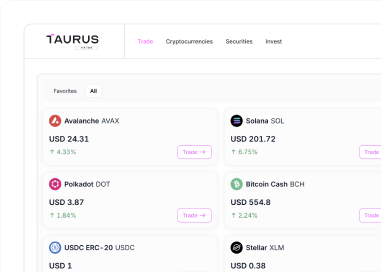
Taurus-PRIME is built to close that gap. It's an institutional-grade trading platform for primary issuance and secondary trading of tokenized assets, operated through a regulated venue.
Depending on an asset's liquidity, it supports OTC trading, auctions, or continuous trading, with access to cryptocurrencies, tokenized assets, and derivatives like futures and options. Every order runs through a FINMA-regulated securities firm, keeping compliance intact from issuance through settlement.
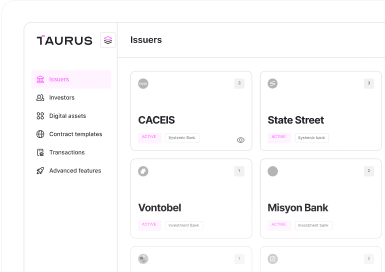
Taurus' client roster reflects this in practice. It includes more than 40 financial institutions and corporations, including State Street, Deutsche Bank, CACEIS, and Misyon Bank. This scale of institutional relationships gives Taurus-PRIME a strong foundation to support secondary market activity.
Taurus in Action: Case Studies
Taurus' platforms are deployed across industries, solving real-world infrastructure challenges for regulated institutions and enterprises.
Here are two examples of how Taurus has helped clients solve real operational challenges:
1. AMINA Bank: Scaling Regulated Crypto Operations
AMINA Bank, a Swiss FINMA-regulated crypto bank, partnered with Taurus in 2019 for its hot storage infrastructure. As AMINA expanded to serve clients across 40+ countries, its needs evolved.
In 2024, AMINA renewed its partnership and upgraded to Taurus-PROTECT v4 with a hybrid deployment model. Taurus manages platform operations and monitoring, while AMINA retains full control of its HSMs and cryptographic keys.
The migration was completed in just four weeks, enabling AMINA to launch new services faster and maintain consistent compliance across client regions.
2. Turbo Energy: Piloting Tokenized Clean Energy Financing
Nasdaq-listed Turbo Energy partnered with Taurus and the Stellar Development Foundation to explore a new way to finance renewable energy projects.
The initiative launched as a proof of concept at a supermarket in Spain, tokenizing debt financing for an on-site solar-plus-battery installation under Turbo Energy's Power Purchase Agreement model.
Using Taurus-CAPITAL, the project issues and manages tokenized debt on the Stellar blockchain.
This enables fractional ownership of clean energy assets, lowering investment barriers and creating a replicable model for financing renewable energy infrastructure.
By integrating tokenization into clean energy financing, Turbo Energy is positioning itself to unlock significant opportunities in this rapidly expanding market.
If these case studies have sparked ideas for your own tokenization journey, we would like to hear from you.
Start a conversation with the Taurus team to learn how their infrastructure can accelerate your enterprise tokenization roadmap.
Disclaimer: This article was published using publicly available information accurate as of August 2026. The information contained herein is for informational purposes only and is subject to change without notice.
Share on




 Taurus-PROTECT Custody
 Taurus-CAPITAL Tokenization
 Taurus-PRIME Trading
 Taurus-NETWORK Collateral
