
Six Security Principles the Binance Incident Puts to the Test
Binance lost about USD 6.3 billion without losing a single private key. For banks and and other financial institutions building on digital-asset infrastructure, that is the lesson worth studying.
On 29 October 2026, attackers drained Binance hot wallets on 10 blockchains, most of it within about 20 minutes. Binance reports no evidence that any private key was stolen. Its signing system did exactly what it was asked to do; it was simply asked by the wrong caller.
That distinction matters for every financial institution running wallet infrastructure, whether built in-house or bought from a vendor. Below, Taurus' security team and CTO office set out what we see as the six lessons, how we approach each in Taurus-PROTECT, and five questions worth putting to your own teams.
Our understanding of the attack: what happened
According to Binance's initial report of 3 November, the attack was a campaign built over months. In September, a software engineer was approached through a legitimate job platform, interviewed by a fake recruiting team, and asked to download a coding assignment containing zero-day malware. From that foothold, the attackers reached wallet engineers' machines and, on 29 October, used stolen credentials to deploy a privileged internal container (see Figure 1 for a simplified, outside-in, view). The FBI has attributed the attack to North Korea.
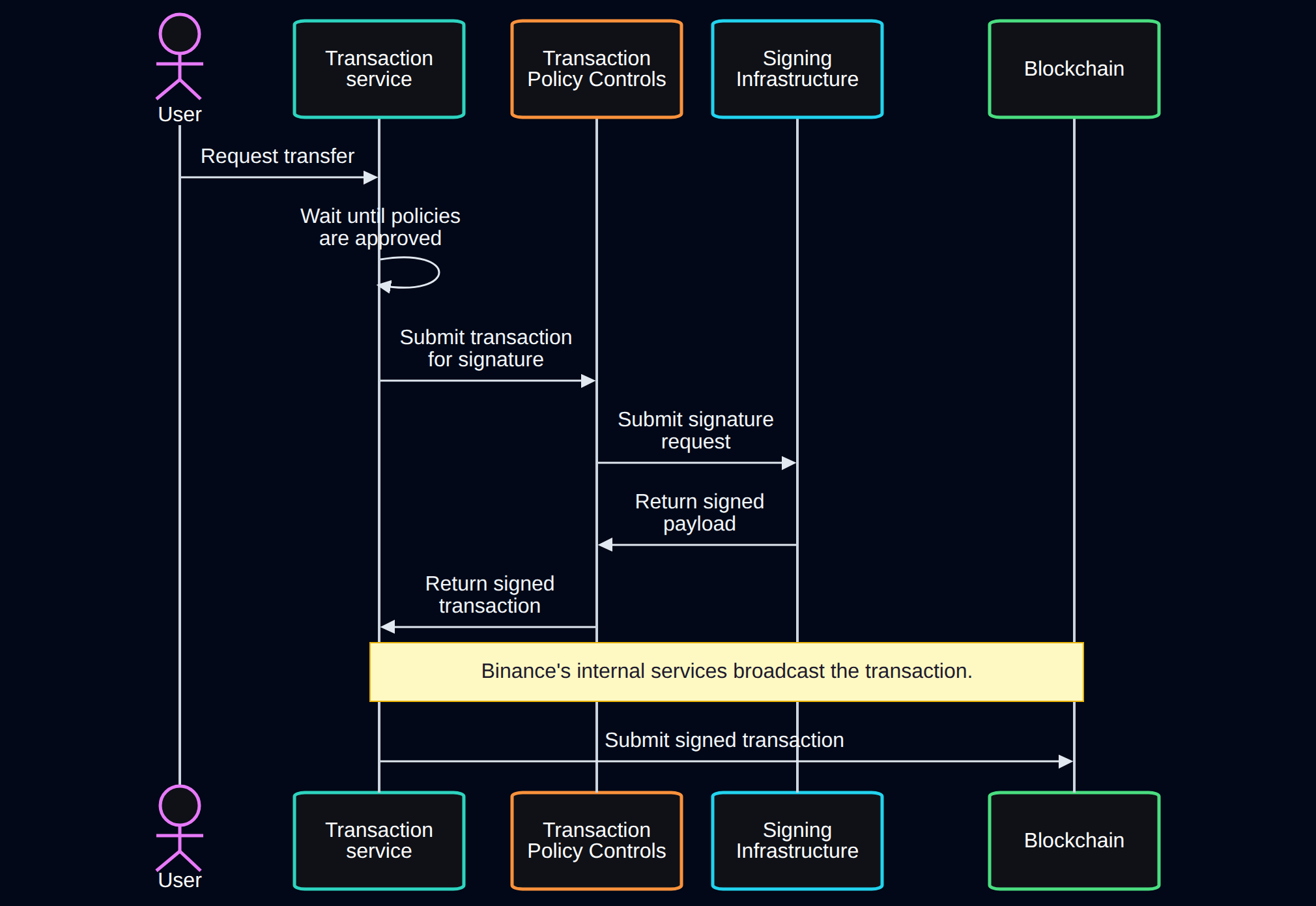
Figure 1: Binance’s normal withdrawal flow. A transfer request goes through the transaction service and the policy controls, which then ask a separate signing infrastructure to sign. Simplified reconstruction based on public information
From that container, the attackers obtained signatures directly rom Binance's signing service, outside the normal withdrawal flow and its policy controls. On Ethereum, they used EIP-7702 to delegate a hot wallet's code to an attacker-controlled contract, with authorisations pre-signed across a range of nonces. The delegation kept sweeping incoming funds for hours after withdrawals were paused, until Binance revoked it at 00:10 UTC on 30 October.
Binance reports about USD 2.85 billion frozen, about 98% of affected tokens replenished from company funds, and has committed to absorb the full loss. Its full post-incident report is still to come; we will update this analysis when it is published.
6 things financial institutions should review
1. Protecting keys is not the same as controlling signatures
The industry has spent a decade hardening key storage. Binance's keys appear to have held. What failed was the path to the signer: policy controls sat in a separate service, and the signer trusted whatever reached it.
How we approach it: in Taurus-PROTECT, the policy engine and the signing keys sit inside the same hardened boundary, an HSM in standard deployments. There is no separate signing component to reach directly; every signature goes through the policy check.
2. A signer should only sign what it understands
A signer that accepts raw hashes or arbitrary payloads cannot tell a withdrawal from a takeover.
How we approach it: the Taurus-PROTECT API offers no raw signing endpoint. Every request must be a known object type, such as an Ethereum transaction or an EIP-7702 delegation, and is evaluated as such.
3. New protocol features need default-deny
EIP-7702 arrived with Ethereum's Pectra upgrade in 2025 to improve wallet usability. It also created a way to hand control of a wallet to a contract with one signature. Every protocol upgrade adds operation types; each should be blocked until explicitly allowed.
How we approach it: EIP-7702 delegations have their own operation type and governance rules. A delegation requires a rule authorising that source address to delegate to that contract, and the contract must be whitelisted and belong to a verified template. Otherwise the request is rejected and users are notified.
4. Assume any single person, device or credential will be compromised
The entry point was a job interview, months before the theft. No perimeter reliably stops a patient, state-sponsored attacker. Security has to hold after the laptop, the server or the admin account falls.
How we approach it: every request needs a quorum of approvers, each signing with their own private key, which the platform never holds; administrator access cannot override this. Funds go only to whitelisted addresses, and whitelist changes need their own quorum, defined by SuperAdministrators using personal hardware or mobile authenticators.
5. Pausing withdrawals is not containment
The malicious delegation lived on-chain, independent of Binance's withdrawal system, and kept sweeping funds for hours after withdrawals stopped. Revoking it required signing a new transaction under pressure. Institutions should plan and rehearse emergency revocation before they need it: who signs, through which approvals, and how fast. They should also monitor their EVM wallets for delegation code where none is expected.
6. Controls are only as strong as their configuration
The best policy engine protects nothing if a single automated key can approve on its own.
Our recommendation: withdrawals, whitelist changes, smart contract calls and delegations should each require at least two independent approvers, with no single automated key able to approve alone.
Five questions to ask your teams or vendors
- If an attacker had full administrator access to your servers and network, could they obtain a single signature?
- Are signing policies enforced inside the same hardware boundary as the keys, or in a separate service the signer trusts?
- Does your signer sign only transaction types it understands, or can it be given raw hashes and arbitrary payloads?
- Is EIP-7702 delegation blocked by default, and allowed only towards contracts you have explicitly approved?
- Who can change your signing policies, and is each change approved by a quorum and verified by the signer?
If any answer is "we're not sure", that is the place to start. Taurus' security experts are available to work through these questions with financial institutions.
Sources
- CoinDesk, 3 Nov 2026: Binance's initial report and media briefing
- Binance, initial findings and response update
- TRM Labs analysis
- Taurus internal security briefing (source draft)
Share on




 Taurus-PROTECT Custody
 Taurus-CAPITAL Tokenization
 Taurus-PRIME Trading
 Taurus-NETWORK Collateral
