
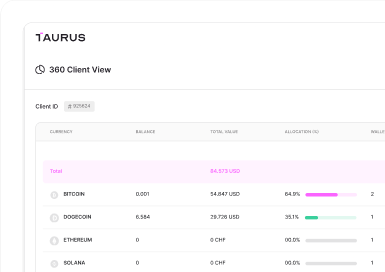



 Taurus-PROTECT Custody
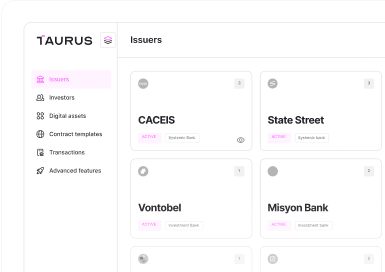
 Taurus-CAPITAL Tokenization
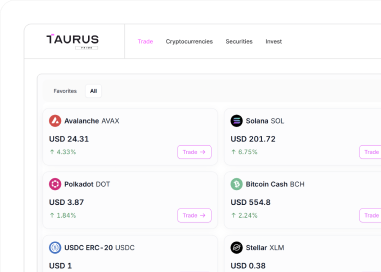
 Taurus-PRIME Trading
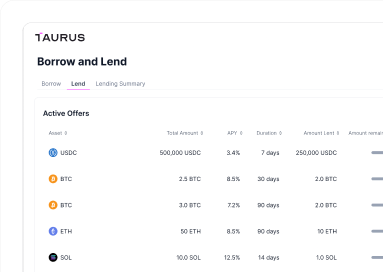
 Taurus-NETWORK Collateral

How banks evaluate digital asset custody technology
When banks compare custody technology providers, eight criteria come up most often: key sovereignty, air-gapped custody, quantum readiness, cloud-agnostic deployment, multi-cloud operation, on-premises capability, market infrastructure connectivity, and native tokenization integration. This guide walks through each of them, what to look for, and how Taurus‑PROTECT answers them, to support your own evaluation.
Key criteria to consider
Eight areas worth exploring with any provider, with the Taurus‑PROTECT answer alongside.
Key sovereignty
Exclusive, provable bank control of keys; no vendor co-signer in the signing path.
✓Full sovereignty on FIPS-certified HSMs; MPC available on top.
Air-gapped custody
A true air gap of the signing device, technical or physical.
✓Both air gap modes, deployed in production.
Quantum readiness
A running program with deployed controls; no MPC-only dependency.
✓Program since 2021; ready since 2025 on every layer Taurus controls.
Cloud-agnostic
Deployable in any cloud, single or multi-region.
✓Since 2019.
Multi-cloud
Runs across several cloud providers at the same time.
✓Since 2019; reduces geopolitical and vendor concentration risk.
On-premise deployment
Full on-premises and sovereign stacks, proven in production.
✓Standard operations; about one in four client institutions on-premises.
Market infrastructure
Connectivity to the shared ledgers banks are adopting.
✓Swift ledger connectivity completed; Swift smart contracts integrated.
Tokenization integration
Custody and tokenization natively integrated under a shared policy engine.
✓Native integration with Taurus-CAPITAL, one shared policy engine. Tokenization guide →
HSM root of trust, MPC on top
Two architectures coexist in digital asset custody. Understanding the difference helps clarify who controls the keys.
HSM root of trust
Private keys exist inside tamper-resistant, FIPS-certified hardware the bank owns and operates, on-premises if required, with audited key ceremonies and bank-controlled backup and recovery. Signing can be air-gapped, technically or physically. No third party is in the signing path, and MPC algorithms are available on top where distributed approval is desired.
MPC-only, vendor-hosted
Key shares are distributed across parties, frequently including co-signing services hosted by the vendor. The bank never holds a complete key, the signing system cannot be air-gapped by design, and hash-based post-quantum signature schemes are mathematically incompatible with MPC. These are useful points to check where your regulator or risk framework requires exclusive, provable control of key material.
Choosing custody technology, explained
What is the best custody technology provider for banks?
HSM vs MPC: which gives full key sovereignty?
Why does the deployment model matter?
Evaluate Taurus‑PROTECT against your own criteria
Banking-grade custody with full private key sovereignty, air-gapped cold storage, and post-quantum readiness, trusted by systemically important banks.