
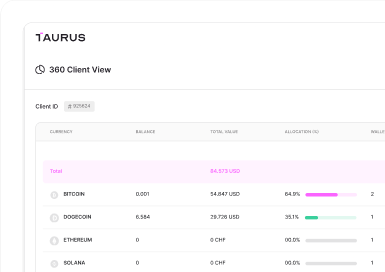



 Taurus-PROTECT Custody
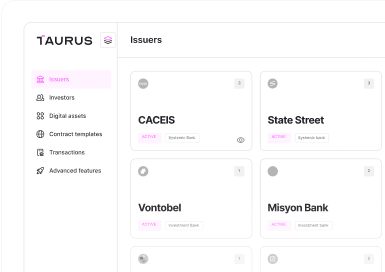
 Taurus-CAPITAL Tokenization
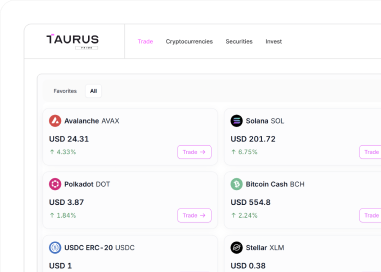
 Taurus-PRIME Trading
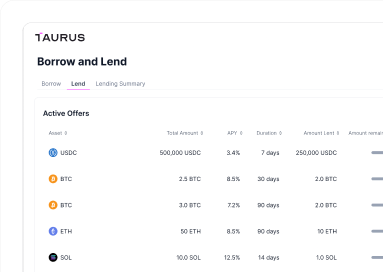
 Taurus-NETWORK Collateral

How banks evaluate tokenization technology
When banks compare tokenization technology providers, seven criteria come up most often: smart-contract agnostic issuance, dynamic smart contract capabilities, blockchain breadth, token standards, native custody integration, regulatory pedigree, and interoperability with shared infrastructure. This guide walks through each of them, what to look for, and how Taurus‑CAPITAL answers them, to support your own evaluation.
Key criteria to consider
Seven areas worth exploring with any provider, with the Taurus‑CAPITAL answer alongside.
Smart-contract agnostic
Any recognized standard, plus your own custom contract.
✓CMTAT, ERC-3643, ERC-1400, chain-native standards, or your own custom contract, uploaded.
Dynamic smart contract capabilities
Contract functions governable at runtime, not hardcoded templates.
✓Since 2020, smart contract capabilities fully dynamic, with the policy engine down to the smart contract function.
Blockchain breadth
EVM, non-EVM, and permissioned chains.
✓45+ chains: Ethereum, Stellar, Solana, Hedera, Base, Polygon, Avalanche, Aztec, Circle Arc; Hyperledger Besu, Canton, RL1.
Token standards
An embedded library of smart contract templates to seamlessly tokenize any type of asset, such as equity, debt, deposits, and stablecoins.
✓Embedded template library: CMTAT, ERC-3643, ERC-1400, plus SPL, SAC, SEP-41 and SEP-57 Soroban, CIP 56 and CIP 112.
Custody integration
Native integration with the custody solution, under a shared policy engine.
✓Native integration with the Taurus-PROTECT custody solution, one shared policy engine. Custody guide →
Regulatory pedigree
Provider itself regulated and audited to banking standards.
✓FINMA-regulated securities firm; ISAE 3402 Type II; ISO 27001; DORA-compliant.
Interoperability
Bank-issued tokenized money on shared infrastructure.
✓Swift smart contracts integrated for Swift ledger, on permissioned Hyperledger Besu.
One platform, every instrument
The standard is the issuer's choice, per instrument and jurisdiction. Here is how the two common platform models compare.
Smart-contract agnostic
Taurus‑CAPITAL issues and services tokenized securities (equity, debt, structured products, funds, real estate) and digital currencies (stablecoins, tokenized deposits, CBDCs) under CMTAT, ERC‑3643, ERC‑1400, chain-native standards, or a custom contract the bank uploads. Contracts are deployed and administered through HSM-secured signing under quorum rules, with the policy engine controlling access down to the individual contract function.
Static, single-standard setups
Some platforms offer static smart contract capabilities tied to one template. In that model the contract adapts less to the instrument, new standards depend on the vendor's roadmap, and issuer keys may sit outside custody governance. Standard breadth and contract-level governance are useful points to explore in a proof of concept.
Choosing tokenization technology, explained
What is the best tokenization platform for banks?
Can we upload our own custom smart contract?
Why does custody integration matter for tokenization?
Evaluate Taurus‑CAPITAL against your own criteria
Asset-agnostic tokenization with the widest blockchain and standard coverage, natively integrated with Taurus‑PROTECT custody.