
Tokenized Deposits for Banks Explained (2026 Guide)
Tokenized deposits are a bank's existing deposits, now built to move on blockchain rails. Simply put, they are a digital upgrade to the money a commercial bank already holds.
What makes them important for banks?
Alternative assets, such as stablecoins and central bank digital currencies (CBDCs), pull liquidity away from commercial banks' balance sheets. When retail customers migrate their money into these digital alternatives, it shrinks the traditional deposit base that banks rely on to fund loans.
Tokenized deposits help compete with this shift, without disrupting what banks are built on.
The safety net, regulatory standing, and credit relationships that define commercial banking remain in place.
What it adds is a new layer of capability: programmable payments, instant settlement, and the infrastructure to compete in digital asset markets that are already taking shape.
The opportunity is real, and the evaluation window is open.
This guide explains what tokenized deposits are, how they work, and why they matter for commercial banks. It also shows how Taurus infrastructure helps banks put them into production.
This Article Contains
- What Are Tokenized Deposits?
- How Do Tokenized Bank Deposits Work?
- Why Tokenized Deposits Matter for Commercial Banks
- What Types of Deposits Banks Typically Tokenize?
- How Banks Put Tokenized Deposits Into Production: A Step-by-Step Roadmap
- Tokenized Deposits vs. Deposit Tokens vs. Stablecoins vs CBDCs
- Tokenized Deposits in Practice (Case Studies)
What Are Tokenized Deposits?
There is no one definition for tokenized deposits as the terminology differs across the industry. In this guide, we distinguish tokenized deposits from deposit tokens based on whether the legal deposit remains off-chain or is natively represented on-chain.
This way, instead of each institution keeping its own separate books, every participant sits on a shared network. Each participant can view the same transaction record in real time. No more back-and-forth reconciliation slowing down payments.
In practice, tokenization adds a programmable wrapper around deposits held at a regulated bank. Each token represents a direct 1:1 claim against the issuing institution. The deposit liability itself doesn't change, and neither does the bank's balance sheet.
This raises a natural question: If the deposit stays the same and only the rails change, is the bank creating a new type of money?
The answer is no. Tokenization of a fiat deposit is a technological upgrade, not a new asset class. The bank's capital structure, regulatory obligations, and core relationship with the customer all stay intact.
So what does change? Traditional bank deposits gain the ability to move programmatically, settle instantly, and interact with smart contracts inside digital ecosystems.
How Do Tokenized Bank Deposits Work?
Tokenized bank deposits run on an added infrastructure layer—APIs that connect a bank's existing ledgers to blockchain environments.
This layer doesn't replace core banking systems. It interfaces with them, turning commercial bank money into programmable money that can move on new rails.
The lifecycle runs in three stages:
1. Issuance
A customer's fiat deposit is confirmed and recorded on the bank’s ledger. The bank's tokenization engine then mints an equivalent digital token on a distributed ledger, each carrying a 1:1 claim against that deposit.
Tokens go only to wallet addresses that are KYC-verified and whitelisted, meaning the bank has pre-approved who can hold or transfer them. Every on-chain movement stays inside the bank's regulated perimeter.
2. Settlement
Smart contracts handle transfers using atomic Delivery-versus-Payment (DvP). The asset and payment legs settle simultaneously, with zero gap and zero counterparty risk.
What used to take two days now clears in seconds, releasing liquidity instantly.
3. Redemption
To exit the ecosystem, a token holder submits a redemption request. The bank verifies the request, burns the tokens, and credits the equivalent fiat amount back to the holder's traditional account.
The 1:1 peg holds throughout, and the bank treats these assets like any other on-balance-sheet liability.
Where banks sit:
Throughout all three stages, the bank stays the gatekeeper, authorizing issuance, setting settlement rules, and controlling redemption. Strong security and access controls protect every step. Unlike permissionless tokens on a public blockchain, nothing moves without approval, which is what makes this a regulated financial institution-grade system.
Why Tokenized Deposits Matter for Commercial Banks
Tokenized deposits aren't just a technical upgrade. They solve problems that traditional payment rails have never been able to fix.
Here's why they matter to your bank.
- Instant settlement, reduced risk: Delivery-versus-payment executes atomically on a shared ledger. The asset and cash legs settle in one transaction, with near-immediate finality and significantly reduced counterparty risk. This is asset tokenization applied to cash.
- Always-on liquidity: Tokenized deposit rails operate around the clock. No batch windows. No cut-off times within participating networks. For banking, this expands liquidity management flexibility well beyond what traditional rails allow.
- Treasury optimization: Always-on rails give corporate treasurers new flexibility. Cash can be swept from idle accounts, concentrated centrally, or pushed to subsidiaries in real time. It means banks have better control over global digital currency flows without waiting for batch processing.
- Programmable payments via smart contracts: Payments execute only when specific conditions are met. A supplier payment settles the moment a digital shipping receipt is confirmed on-chain. The same logic applies to escrow, making it automated and verifiable. This gives financial institution operations direct, programmable control over tokenized assets.
- Balance sheet integrity: Unlike stablecoins or other digital currency alternatives, tokenized deposits stay on the bank's balance sheet. Since deposits don't leave the traditional banking system, lending capacity stays intact, and credit intermediation continues without leakage.
- Regulatory continuity: Where a tokenized deposit is structured as a qualifying bank deposit, existing deposit insurance, capital requirements, and central bank liquidity continue to apply. Tokenized deposits bring these protections into digital ecosystems.
- Capital efficiency: Traditional settlement cycles lock up fiat currency while payments clear. Instant settlement removes that delay, freeing capital that would otherwise sit idle in transit and improving returns on existing deposits without additional risk.
Transformation is one thing. Practical application is another. Here is where banks typically start.
What Types of Deposits Banks Typically Tokenize?
The tokenized deposit implementation typically starts with four traditional deposit types:
- Institutional deposits: High-value client deposits, now tokenized to enable instant settlement, round-the-clock liquidity, and programmable payment flows at a scale traditional rails can't match.
- Interbranch liquidity deposits: Internal branch deposits, tokenized to move bank money across global branches instantly, eliminating correspondent network delays and freeing trapped liquidity across time zones.
- Programmable corporate deposits: Smart contracts automate conditional payments, such as supply chain finance and escrow, releasing funds only when pre-agreed conditions are verified on-chain.
- Currency-specific deposits: Banks issue tokenized deposits in major fiat currencies to join regulated pilots and interbank networks, helping them compete with payment stablecoins (like USDC or PayPal's PYUSD) in specific jurisdictions.
Once you've finalized which type of deposit to tokenize, it's time to actually put the infrastructure in place.
How Banks Put Tokenized Deposits Into Production: A Step-by-Step Roadmap
Deposit tokenization is not a technology experiment. It is a staged infrastructure program.
Banks that do this well start narrow, control risk, prove value, and then scale toward interoperability.
Here’s a clear roadmap:
Step 1: Start With One Business Problem
Step 2: Establish your legal footing before anything else
Step 3: Choose the Operating Model
Step 4: Connect the Token Layer to Core Banking
Step 5: Build the Mint, Transfer, and Burn Flow
Step 6: Add Compliance and Access Controls
Step 7: Add Programmability Carefully
Step 8: Pilot with a Small Client Group
Step 9: Expand Into Production
Step 10: Plan for Interoperability From Day One
Step 1: Start With One Business Problem
Pick a single use case where existing payment rails fall short: Cross-border treasury transfers, interbranch liquidity, trade finance settlement, or collateral movement.
The strongest programs solve a real operational pain point, not a standalone innovation project.
Step 2: Establish your legal footing before anything else
The legal structure of the deposit liability stays the same whether it sits on-chain or off-chain. That said, banks must actively confirm this—not assume it.
Before moving forward:
- Confirm deposit insurance coverage explicitly with your primary regulator.
- Establish a reconciliation framework that keeps token supply matched to deposit balances at all times.
- Maintain deposit account records on the distributed ledger to satisfy existing accounting and reporting standards.
Next, decide how the tokenized deposit liability is structured:
- Non-native: The deposit stays on your existing ledger, with a token representing it on-chain. Safer and easier to supervise.
- Native: The tokenized asset is recorded directly on the blockchain. More ambitious, but legally less certain today.
Step 3: Choose the Operating Model
Decide who can access your tokenized deposit infrastructure and under what rules. Here are three operational model choices:
- Single-bank private ledger: Tokens move only within your own infrastructure. The lowest-risk entry point.
- Consortium network: Selected banks or another regulated financial institution participate under shared rules. Broader utility, still controlled.
- Public blockchain with permissioned access: Maximum interoperability, but the most complex to govern and supervise.
Most banks start with a private model for control, then expand to consortium or public networks for interoperability.
Getting the infrastructure right from the start makes this progression significantly easier.
That’s where platforms like Taurus come in.
Taurus‑CAPITAL (Taurus’s tokenization solution) is asset-agnostic and supports broad DLT coverage, from permissioned networks like Hyperledger BESU to public EVM and non-EVM protocols.
This allows your bank to start with a low‑risk private ledger and seamlessly transition to consortium or public models as your strategy evolves. You can manage all of these environments through a single, unified asset‑agnostic interface.
Step 4: Connect the Token Layer to Core Banking
Link the tokenized deposit infrastructure directly to deposit accounts, the general ledger, treasury, and sanctions systems.
Run automated reconciliations continuously to prove that digital token supply matches deposit balances at all times.
This is not a peripheral integration—treat it with the same resilience and recovery standards as core banking systems. Without this, the bank money behind every token cannot be verified. And without verification, there is no credible settlement.
Step 5: Build the Mint, Transfer, and Burn Flow
The core workflow is simple. When funds arrive in an eligible account, the bank mints matching tokens. Those tokens move between approved wallets.
When a holder wants to exit, the bank burns the tokens and credits the linked fiat account.
The bank must define the rules for each action upfront.
Who can request a mint?
What validates a transfer?
How do you handle redemption?
Build the logic into your smart contracts and orchestration layer. Test every edge case before going live.
The right orchestration layer removes the complexity from this process.
Taurus‑CAPITAL provides a seamless orchestration layer across the entire asset lifecycle, allowing you to trigger mint and burn operations directly via secure API calls.
Transaction signing and key management are secured through Taurus‑PROTECT, which leverages cutting-edge Hardware Security Modules (HSMs) to protect private keys. This ensures institutional‑grade security for every movement of funds.
Step 6: Add Compliance and Access Controls
Incorporate both access controls and compliance monitoring at every stage:
- Permissioned wallets and whitelisting: Restrict participation to KYC-verified entities only.
- AML monitoring and sanctions screening: Screen every transaction in real time.
- Role-based permissions: Define who can mint, transfer, or burn.
- Auditability: Log every mint, transfer, and burn for regulatory review.
This is what makes tokenized deposits workable inside a regulated financial institution environment rather than just on an open blockchain.
Taurus provides embedded, multi-jurisdictional compliance tools with smart contract whitelisting and built-in full audit trails.
You can define specific on‑chain and off‑chain governance rules to ensure only KYC‑verified entities can interact with your tokenized deposits. The platform maintains full audit trails for every transaction, ensuring your program remains transparent and ready for regulatory review.
Step 7: Add Programmability Carefully
Once the basic flow works, add smart contract logic for conditional payments.
For example, escrow that releases funds automatically when a shipping receipt is confirmed on-chain. Or treasury sweeps that move idle cash into higher-yielding accounts at preset times.
Test every contract thoroughly. Scope it narrowly. Prove the value. Then expand.
A platform that simplifies smart contract deployment reduces the risks during this phase.
Taurus‑CAPITAL offers a vast library of templates and custom smart-contract capabilities, enabling your bank to implement conditional payments, such as automated escrow or treasury sweeps.
You can program complex logic at the function level to mirror your operating model—without extra engineering—and safeguard everything with native Taurus‑PROTECT security.
Step 8: Pilot with a Small Client Group
Start with a limited group of institutional clients. Test operating hours, exception handling, liquidity behavior, and audit controls. Gather feedback, identify bottlenecks, and refine your workflows before scaling.
A pilot proves operational value, not just technical feasibility. It validates real transaction flows and settlement finality in a controlled environment.
Step 9: Expand Into Production
After a successful pilot, widen the program to more clients and payment flows. Shift focus from experimentation to reliability, governance, and measurable business impact.
Build 24/7 liquidity management and real-time monitoring.
Remember to expand incrementally, adding new client segments one at a time.
Step 10: Plan for Interoperability From Day One
Even if your initial phase is closed-loop, long-term value requires connecting with other banks and networks.
Here is how to go about it:
- Build DLT-agnostic infrastructure (able to work across different blockchain and distributed ledger technologies).
- Adopt common messaging standards like ISO 20022.
- Join industry initiatives shaping shared standards (e.g., Regulated Liability Network).
This ensures your tokenized bank deposits can move across ledgers and interoperate with tokens from other commercial banks.
The end state is straightforward: Central bank money and commercial bank liabilities settling instantly on shared rails.
The infrastructure you choose today determines whether that end state is achievable.
Taurus ensures your tokenization layer remains compatible with emerging blockchain protocols and messaging standards.
Through Taurus‑NETWORK, your bank gains access to a broad interbank collateral and settlement ecosystem for real‑time cross‑chain operations. The network currently connects regulated financial institutions across 10 countries on a blockchain‑agnostic interbank settlement layer.
That is what interoperability looks like in practice.
At this stage, it helps to know how tokenized deposits compare to stablecoins, CBDCs, and deposit tokens.
Tokenized Deposits vs. Deposit Tokens vs. Stablecoins vs CBDCs
Before banks can evaluate the opportunity, they need a clear view of how tokenized deposits differ from other digital money instruments.
The table below lays out the distinctions:
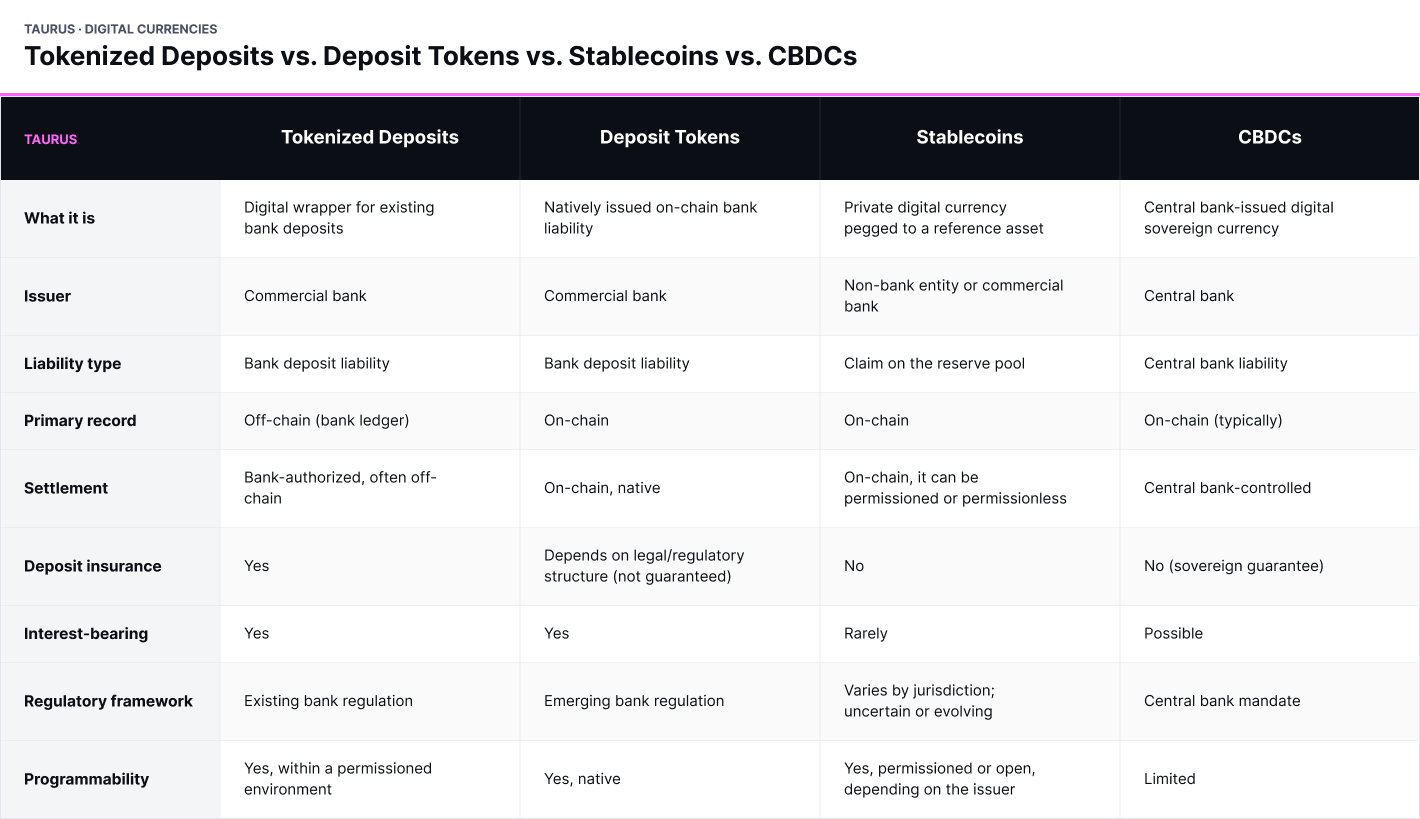
The value proposition for tokenized deposits is clear. What strengthens the case are real-world implementation examples. Let's look at them.
Tokenized Deposits in Practice (Case Studies)
Several major banks have already moved tokenized deposits into live production. Here is a snapshot of where they stand.
1. J.P. Morgan — Kinexys
J.P. Morgan's blockchain platform, rebranded from Onyx to Kinexys in November 2024, has processed over $3 trillion in transactions since inception.
The bank launched JPM Coin (JPMD) as a proof-of-concept in June 2025, with B2C2, Coinbase, and Mastercard successfully completing test transactions. The deposit token became available to institutional clients on Coinbase's Base network in November 2025.
It also formed a framework with DBS to create shared standards for cross‑blockchain tokenized deposit transfers.
The takeaway for banks: This is no longer an internal experiment. Tokenized deposits are moving onto public rails and into multi‑bank interoperability.
2. Citi – Citi Token Services
Launched in September 2023, Citi Token Services converts client deposits into digital tokens for 24/7 cross-border payments, liquidity management, and trade finance. In an early pilot with Maersk and a canal authority, the service reduced settlement times from days to minutes.
It now processes billions in transactions. Clients are not required to hold or manage tokens directly.
The takeaway for banks: Banks have successfully begun embedding tokenized deposits into live treasury and trade‑finance workflows, delivering measurable operational speed gains for institutional clients.
The Path Forward for Commercial Banks
The pattern is clear. Tokenized deposits are no longer experimental. They are settling real value, shortening settlement cycles, and pulling the traditional banking system into a faster, more connected era of multi-bank interoperability.
If your bank is ready to move from evaluation to execution, the right infrastructure partner makes all the difference. Taurus-CAPITAL, Taurus-NETWORK, and the broader Taurus platform give banks a proven, regulated path to issue, manage, and scale tokenized deposits with confidence.
Ready to put tokenized deposits into production? Book a meeting with the Taurus team to see how their infrastructure can support your bank's tokenization strategy from day one.
Disclaimer: This article was published using publicly available information accurate as of July 2026. The information contained herein is for informational purposes only and is subject to change without notice.





 Taurus-PROTECT Custody
 Taurus-CAPITAL Tokenization
 Taurus-PRIME Trading
 Taurus-NETWORK Collateral
