
Tokenized Money Market Funds: What They Are + How They Work
A tokenized money market fund (TMMF) is a traditional money market fund whose shares are represented as digital tokens on a distributed ledger.
That same mechanism is already reshaping other asset classes. Deposits, collateral, and repo have all seen early tokenization. Money market funds were slower to gain traction than these use cases. But the catch‑up phase is now underway.
In 2025, tokenized money market funds grew 110% in assets under management, from $4 billion to $8.6 billion. Major asset managers like J.P. Morgan, BlackRock, and Franklin Templeton are already in production.
The infrastructure is live, and traditional finance institutions are proving institutional use cases in production environments. Early adopters are already capturing measurable gains.
As more financial institutions enter production and client expectations shift toward 24/7 access, the advantage of being a first mover diminishes.
So the time to evaluate is now.
This guide explains what tokenized MMFs are, how they work, their benefits, and a step‑by‑step roadmap for bank implementation.
This Article Contains
- What Are Tokenized Money Market Funds
- 5 Measurable Benefits of Tokenized Money Market Funds
- How Tokenized MMFs Work (Operational Model)
- Tokenized MMFs: Implementation Roadmap for Banks
- 4 Pitfalls Common With Tokenized MMFs Implementation (+ How to Avoid Them)
- Why Banks Must Prioritize Tokenized MMFs in 2026
What Are Tokenized Money Market Funds
Think of a tokenized MMF as a traditional money market fund whose shares now live on a distributed ledger as digital tokens.
What’s a distributed ledger?
It’s a shared database maintained across a network of computers rather than by a single central authority.
Depending on the legal structure, each token typically represents ownership of, or a beneficial interest in, shares of the underlying money market fund. The assets of the funds can be government securities, repurchase agreements, or other eligible instruments.
The fund's investment strategy, portfolio composition, and risk profile remain unchanged.
What changes is the infrastructure underneath:
- Ownership records move from centralized registers to a shared, cryptographically secured ledger.
- On-chain transfers can settle within seconds, while overall transaction processing speed depends on the fund’s operational design and off-chain processes.
- Transfers can reduce reliance on traditional reconciliation processes.
Banks today are already trading stablecoins, tokenized deposits, and other digital currencies. Each comes with trade-offs that tokenized money market funds resolve. The comparison below makes the differences clear.
That raises a practical question for banks already working with stablecoins and tokenized deposits: how does a tokenized MMF fit alongside these instruments, and where does it serve a purpose they cannot?
Tokenized MMFs vs Deposit Tokens Stablecoins and Cryptocurrencies
The table below maps out the key differences:
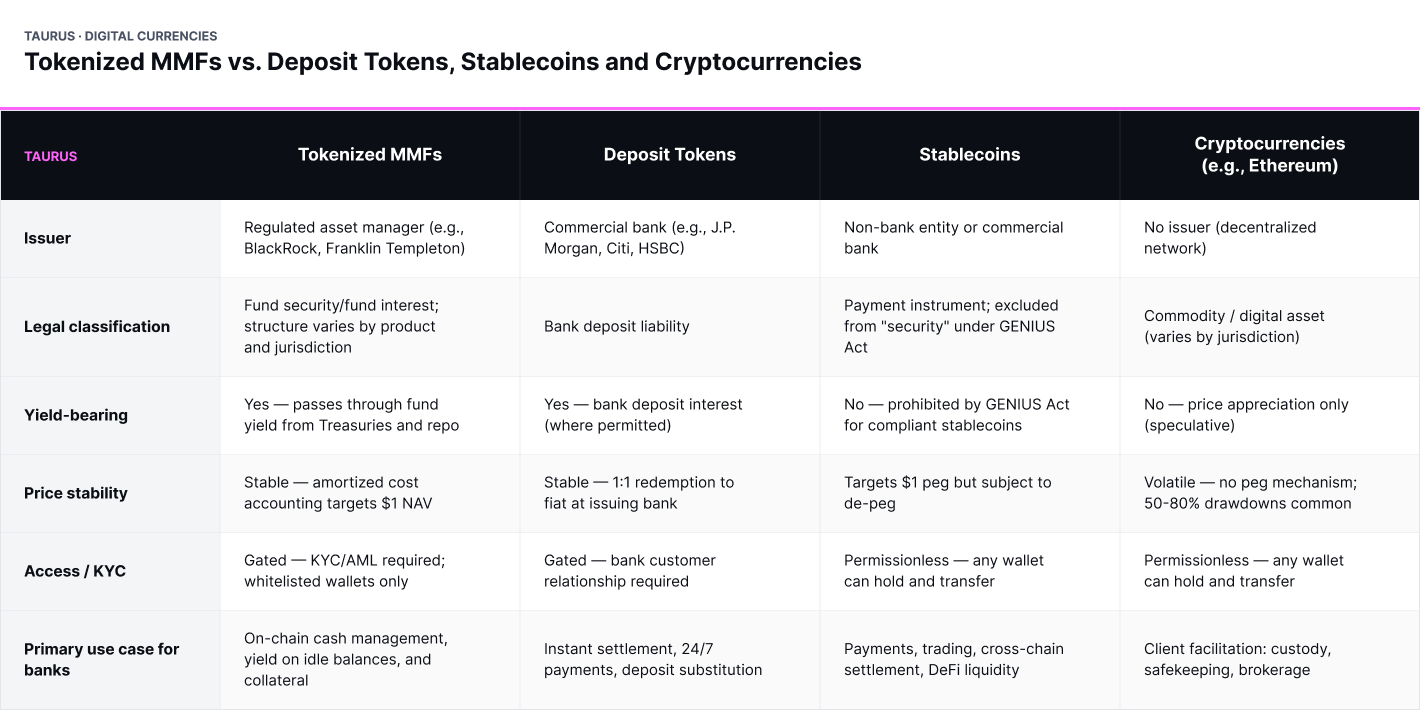
The comparison above shows where tokenized MMFs fit. Here is what they actually deliver.
5 Measurable Benefits of Tokenized Money Market Funds
Traditional money market funds have three structural limitations:
- Market-hour trading only: Traditional money market fund shares cannot be bought, sold, or transferred outside business hours.
- Multi-day settlement: Traditional MMFs are limited by market hours and processing windows, leaving capital trapped in transit.
- Monthly yield cycles: Interest accrues daily but is distributed monthly. Treasurers cannot see or access yield until the cycle closes.
Tokenized MMFs offer several benefits that help overcome these limitations:
1. Better Liquidity Management
Unlike traditional finance settlement systems, tokenized MMF shares can often be transferred at any time, including weekends and holidays.
For bank treasury teams, this can improve intraday liquidity management and operational flexibility.
When fund shares are accessible around the clock, treasurers can deploy or recover cash precisely when needed, rather than waiting for markets to open.
2. Near-Instant Settlement
Atomic delivery-versus-payment (DvP), where securities and cash transfer simultaneously, can significantly reduce settlement gaps.
What typically takes T+1 or T+2 in traditional money market funds clears in seconds, reducing counterparty exposure and lowering the need for intraday credit lines.
3. Intraday Yield Distribution
By embedding fund logic into smart contracts, tokenized MMFs can automate yield accrual and distribution.
This gives institutional investors greater visibility into returns as they accrue, improving cash management and forecasting.
4. Collateral Mobility
The CFTC staff guidance clarified that tokenized MMF shares may qualify for collateral use if they meet applicable risk and regulatory requirements.
Tokenized fund shares transfer directly as margin or collateral without redeeming to cash first. This eliminates the two- to three-day gap where capital sits idle, and yield stops accruing.
Banks may be able to meet intraday margin calls more efficiently using existing MMF positions rather than drawing on credit facilities. This can reduce borrowing costs and liquidity drag.
5. Programmability Via Smart Contracts
Tokenized money market funds embed conditional logic directly into the token.
Payments are executed only when pre-agreed conditions are met, and funds remain invested until trigger events occur.
The same logic automates treasury sweeps, moving idle cash into MMFs without manual intervention and minimizing uninvested cash balances.
So how does tokenization deliver those gains? Here’s how they work.
How Tokenized MMFs Work (Operational Model)
Tokenization adds a blockchain layer on top of existing fund infrastructure. Your bank does not need to rebuild core systems. You just need to connect them to a blockchain.
The process cycles through three core steps:
1. Issuance (Minting)
An investor—whether a corporate treasury, pension fund, or retail client—subscribes to the fund through the bank.
The bank verifies KYC/AML and confirms the client's wallet is whitelisted.
The fund manager verifies the subscription, and MMF tokens are minted to the client's wallet, based on the fund’s current NAV per token. Each digital token represents a pro-rata interest in the tokenized money market fund.
The number of tokens issued equals the investment amount divided by the fund’s current NAV per token.
2. Transfer
The client sends MMF tokens directly to another whitelisted wallet. The smart contract verifies that the receiving wallet is approved. The transfer completes in seconds.
The transfer agent mirrors the movement in off-chain records.
3. Redemption
The bank receives a redemption request from the client. It verifies the request against the client's token holdings and confirms all conditions are met.
The MMF tokens are then burned, removing them from circulation. The fund pays out fiat or stablecoins to the client's account, completing the redemption cycle.
The operational model is straightforward. But the implementation requires careful planning. Here is how to approach it.
Tokenized MMFs: Implementation Roadmap for Banks
Here’s a step-by-step guide to tokenize your fund assets:
- Step 1: Select Your Legal Structure
- Step 2: Choose Your Blockchain Environment
- Step 3: Establish Whitelisting, Compliance, and Digital Identity Controls
- Step 4: Integrate With Transfer Agent and Custody Systems
- Step 5: Implement NAV and Oracle Infrastructure
- Step 6: Build Cybersecurity and Operational Safeguards
- Step 7: Enable Collateral Use Cases
- Step 8: Secure Regulatory Approvals
- Step 9: Test With a Sandbox or Pilot
- Step 10: Plan for Cross‑Chain Interoperability
Step 1: Select Your Legal Structure
The first step is to determine how your fund's legal ownership will map to the blockchain.
Tokenization offers four legal models, each with different trade-offs between integration effort and authoritative record-keeping:
- Digital Mirror: Creates a non-authoritative on-chain copy of the traditional off-chain register. The blockchain mirrors ownership for internal or operational visibility only. Best for banks experimenting with asset tokenization without changing existing legal frameworks.
- Digital Twin (Distributor): The official register remains off-chain while the distributor maintains an on-chain nominee register. Investors receive tokens representing beneficial interest; legal ownership stays with the nominee. Best for large distribution platforms wanting tokenization benefits without restructuring funds.
- Digital Twin (Feeder Fund): Creates a new tokenized feeder fund that invests in an existing traditional master fund. Ownership register goes on-chain; tokens represent feeder units. Best when the master fund cannot be modified.
- Digital Native: Blockchain is the sole authoritative register. Tokens are the shares. Subscriptions, redemptions, and transfers execute via smart contracts. Best for full tokenization with confident demand.
Step 2: Choose Your Blockchain Environment
Select a DLT network that aligns with your institutional finance needs.
- Private/Permissioned: Only approved participants can access the network. Offers full privacy but limited connections to outside systems. Best for banks prioritizing control and confidentiality.
- Public permissioned: Anyone can see the network, but only approved wallets can hold your tokens. Offers maximum interoperability with other institutions while maintaining compliance controls.
- Multi-chain: Your tokens can move across multiple blockchains. Offers future flexibility but adds operational complexity.
Most banks start with a public permissioned network to maximize connectivity while maintaining compliance controls. Getting the infrastructure right from the start makes future expansion easier.
That's where platforms like Taurus come in.
Taurus‑CAPITAL (Taurus’ tokenization platform) is built specifically to tokenize fund structures such as MMFs, with native support for equity, debt, and fund vehicles across both public and private blockchains.
It’s asset-agnostic and supports broad DLT coverage, from permissioned networks like Hyperledger Besu to public EVM protocols (Ethereum, Polygon, Avalanche) and non-EVM protocols (Stellar, Solana, Tezos).
This allows your bank to start with a private ledger and seamlessly transition to public or multi-chain models as your strategy evolves—all through a unified interface
Step 3: Establish Whitelisting, Compliance, and Digital Identity Controls
Implement "allow lists" in smart contracts so tokens only transfer to KYC‑approved wallets.
Maintain the fund manager's ability to freeze or recover tokens in response to court orders.
Ensure sanctions screening executes automatically on every transfer.
Design reusable digital identities that allow clients to verify their status without exposing personally identifiable information on‑chain.
Step 4: Integrate With Transfer Agent and Custody Systems
The transfer agent maintains the official shareholder register for Digital Mirror and Digital Twin models. On‑chain token movements must mirror off‑chain records.
For Digital Native models, the on‑chain register is authoritative, and the transfer agent shifts to reconciliation.
Establish who holds private keys and under what legal framework. Implement multi‑signature governance.
Step 5: Implement NAV and Oracle Infrastructure
The fund administrator calculates NAV off‑chain using standard accounting rules. An oracle then publishes that NAV to the blockchain so subscriptions and redemptions price correctly.
For collateral use cases, continuous pricing may be needed rather than just daily NAV. Multiple independent oracle providers prevent a single point of failure.
Step 6: Build Cybersecurity and Operational Safeguards
Audit all smart contracts through independent security firms. Manage private keys using multi‑signature wallets and hardware security modules.
Install redemption circuit breakers that halt processing during anomalies.
These safeguards protect both the bank and its institutional investors.
Supporting these safeguards requires the right infrastructure.
Taurus‑PROTECT delivers banking‑grade custody with FIPS 140‑2 Level 3 HSM security, multi‑layered controls across hot, warm, and cold storage, and ISAE 3402 Type II certification.
Step 7: Enable Collateral Use Cases
One of the strongest institutional use cases for tokenized MMFs is collateral management. To fully capture this demand, design your digital token to support margining, substitution, and real‑time movement without redeeming to cash first.
Managing this collateral workflow at scale requires a purpose‑built network.
Taurus‑NETWORK connects institutions for real‑time collateral pledging and settlement. It automates compliance and lets you configure pledging rules—asset type, notice period, minimum duration, and approval workflows—through a collateral rule engine.
Step 8: Secure Regulatory Approvals
Secure necessary approvals before launch, but don't treat this as a hurdle. Regulators in several jurisdictions are providing greater clarity around tokenized assets.
- The OCC has confirmed that banks can act as crypto intermediaries through "riskless principal" transactions and provide custody services without prior approval.
- The CFTC launched a pilot program to accept digital assets, including tokenized MMFs, as collateral for derivatives.
- The US SEC's leadership has discussed a possible innovation exemption, but tokenized securities remain subject to federal securities laws unless registered or exempt. SEC staff has also stated that tokenized securities are still securities, and the form of representation on a blockchain does not remove securities-law obligations.
Engage regulators early to take advantage of this clarity.
Step 9: Test With a Sandbox or Pilot
Run a pilot with a small group of clients before scaling. Test eligibility determination, margining, substitution, settlement, and exception handling.
Participate in industry sandboxes like MAS Project Guardian or the FCA Digital Securities Sandbox.
This reduces operational risk before full deployment.
Step 10: Plan for Cross‑Chain Interoperability
If you operate only on a single private chain, your tokenized assets become trapped in a silo. Major institutions already connect private and public chains to avoid fragmentation.
Design for interoperability from day one. Taurus‑NETWORK supports settlement across 30+ blockchains and fiat rails, ensuring your tokenized MMFs can move where your counterparties are.
Decide between lock‑and‑mint versus burn‑and‑mint bridging models.
Clearly, tokenizing funds delivers real efficiency gains. But execution carries distinct risks. With proactive planning, all of them are manageable.
4 Pitfalls Common With Tokenized MMFs Implementation (+ How to Avoid Them)
Here are four pitfalls common to tokenized MMFs implementation:
1. Promising 24/7 Redemptions You Cannot Deliver
Token transfers settle instantly, but when investors redeem for cash, the underlying treasury assets still settle T+1.
Under normal conditions, that gap is manageable. During stress, however, it can accelerate runs.
The Bank for International Settlements (BIS) has explicitly flagged this liquidity mismatch as a structural risk.
How to avoid: Clearly disclose which operations are truly 24/7 and maintain liquidity buffers to bridge settlement gaps.
2. Fragmented Whitelists Across Funds
Each fund maintaining its own allow-list restricts peer-to-peer transferability and fragments liquidity across your tokenized funds.
The BIS notes this is impractical at scale and limits wider use for margining.
How to avoid: Build a unified, dynamically updated whitelist across all tokenized products, so transfers remain seamless without compromising compliance.
3. Single Point of Failure in Key Management
A compromised private key can result in loss of control if safeguards are inadequate. It’s because blockchain transactions are generally difficult to reverse once confirmed.
The CFA Institute identifies key theft as a primary threat, with smart contract bugs and protocol‑layer compromises adding to the risk.
How to avoid: Use multi‑signature wallets requiring multiple independent approvals for any transfer. Deploy hardware security modules and strict access controls. Leveraging a high‑security platform, like Taurus‑PROTECT, can lower the risk of single points of failure in key management.
4. Stablecoin Contagion Risk
If your fund redeems into stablecoins, a de‑pegging event could trigger a run as investors rush to exit. The BIS warns that interlinkages between TMMFs and stablecoins create feedback loops that can accelerate stress.
Some TMMFs enable rapid conversions into stablecoins or are used for leveraged trades, amplifying contagion. The International Organization of Securities Commissions (IOSCO) has flagged spillover effects from increased connections to crypto markets.
How to avoid: Maintain liquidity buffers independent of stablecoins. Set clear redemption cut‑off times.
For many institutions, the fund tokenization benefits may outweigh the risks when implemented with appropriate controls.
Several banks are already demonstrating this with their rollouts.
Why Banks Must Prioritize Tokenized MMFs in 2026
Money market fund tokenization is moving from pilot to production. The question is no longer if banks should act, but whether they can afford not to.
Here is the evidence:
1. 2026 Tradeweb ICD Portal Client Survey
Tradeweb surveyed 120 treasury professionals in January 2026. The findings are telling.
One in four respondents (25%) expressed moderate to strong interest in tokenized MMFs. At the same time, 27% of firms plan to increase their money market fund allocations in 2026.
Takeaway for banks: Corporate treasury teams are not chasing speculation. They are moving toward instruments that offer stability, yield, and better liquidity access. Tokenized money market funds sit precisely at that intersection.
2. J.P. Morgan Tokenized MMF Rollout
In December 2025, J.P. Morgan launched MONY—its first tokenized money market fund—on public Ethereum. The fund was seeded with $100 million of the bank's own capital.
Five months later, J.P. Morgan launched a second fund, JLTXX, a registered government money market fund structured for stablecoin issuers under the GENIUS Act.
Both funds are accessible to qualified investors through Morgan Money, J.P. Morgan's institutional liquidity platform.
Takeaway for banks: One of the largest global systemically important banks has committed $200 million of its own capital to tokenized funds. The market is no longer theoretical.
3. J.P. Morgan Asset Management (Whitepaper)
J.P. Morgan Global Liquidity business managed $1.5 trillion, including $1.2 trillion in money market funds (as of 31 December, 2025). The dedicated whitepaper quantified the operational gains of tokenization.
It noted that atomic settlement cuts processing time by 60 to 90 minutes per transaction compared to conventional off-chain workflows. For banks running high volumes of MMF tokens, that time saving compounds into meaningful cost reduction and freed liquidity at scale.
Takeaway for banks: This is not a theoretical efficiency argument. It is a documented, measurable gain from the world's largest asset management firm actively deploying the technology.
4. The Value Exchange Survey Sponsored by Taurus
A new study from The ValueExchange breaks down the real-world impact of tokenized money market funds (TMMFs). Sponsored by Taurus and supported by Global Digital Finance and ISDA, the research synthesized insights from 335 global market participants.
The core conclusion? Tokenization delivers true value when it transforms an asset's functional utility.
For money market funds, tokenization optimizes how fund shares are transferred, pledged, tracked, reconciled, and controlled.
Key Research Findings
- Rapid Adoption Ahead: 66% of surveyed firms intend to debut TMMFs by the end of 2027.
- Overnight Stagnation: In North America, 79% of MMF investments remain locked in overnight holdings.
- Collateral Friction: Currently, 51% of firms are unable to use MMFs as collateral, and a mere 16% pledge amounts exceeding USD 50 million.
- Demand for Speed and Access: 44% of participants rank 24/7 mobility for fund share transfers as a critical feature, while an equal 44% prioritize instantaneous transfers with instant finality.
- Financial Upside: Transitioning to TMMFs could unlock more than USD 238 million in extra interest earnings per firm.
The Bottom Line
For banks and financial institutions, the value proposition is clear: tokenizing MMF shares allows them to evolve past simple overnight cash management and become highly active assets utilized in treasury operations, collateral management, and settlement processes.
Tokenize Your Funds With Taurus
Tokenized MMFs are settling real value, and early adopters are capturing measurable gains. The roadmap is proven, the risks are manageable, and client demand is growing.
If your bank is ready to move from evaluation to execution, the right infrastructure partner makes all the difference. That's where Taurus fits in. Taurus offers a proven, regulated path to issue, manage, and scale tokenized MMFs with confidence.
Start a conversation with the Taurus team to learn how their infrastructure can accelerate your fund tokenization roadmap.
Disclaimer: This article was published using publicly available information accurate as of July 2026. The information contained herein is for informational purposes only and is subject to change without notice.





 Taurus-PROTECT Custody
 Taurus-CAPITAL Tokenization
 Taurus-PRIME Trading
 Taurus-NETWORK Collateral
